

Polluted Air Harms Hearts More in Individuals with Cardiovascular-Kidney-Metabolic Syndrome
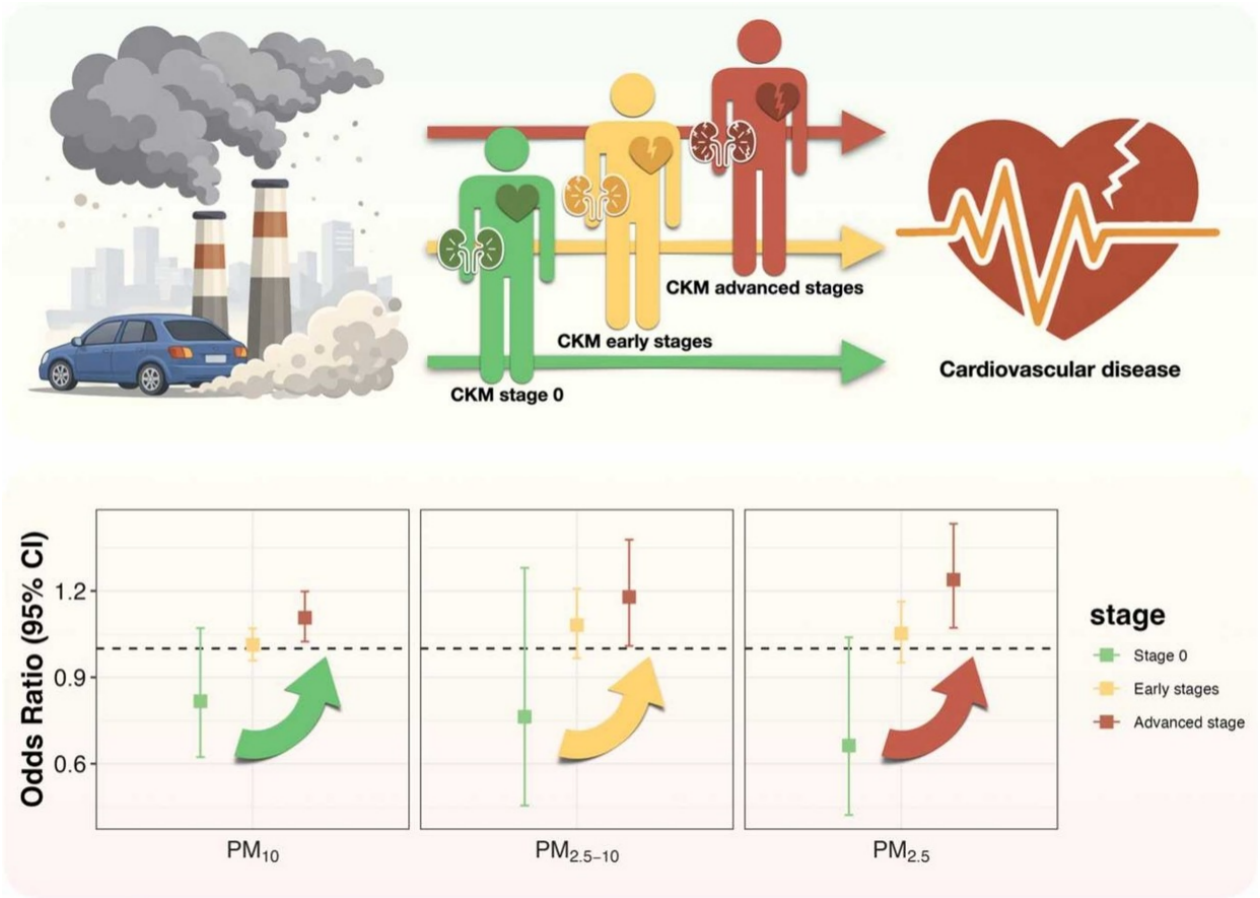
Graphical Abstract
GA, UNITED STATES, May 19, 2026 /EINPresswire.com/ -- A study of over 3,100 middle-aged and older adults in China found that long-term exposure to particulate matter (PM2.5 and PM2.5-10) significantly increases the risk of heart disease. The risk is highest for those with advanced cardiovascular-kidney-metabolic (CKM) syndrome. Accelerated biological aging explained about 9% of this effect, highlighting the need for targeted protections.
Long-term exposure to air pollution significantly increases the risk of cardiovascular disease (CVD), with the greatest danger facing individuals who already have cardiovascular-kidney-metabolic (CKM) syndrome, according to a new study published in Intelligent Climate and Eco-Environment.
Researchers from Fudan University analyzed data from 3,103 participants in the China Health and Retirement Longitudinal Study (CHARLS) over a four-year period. They found that for every 10 μg/m³ increase in fine particulate matter (PM2.5) and coarse particulate matter (PM2.5–10), the odds of developing CVD rose by approximately 10%.
The study is the first to show that CKM syndrome—a condition encompassing the interconnected risks of heart disease, kidney disease, diabetes, and obesity—significantly modifies this risk.
“We observed a clear gradient: individuals at more advanced CKM stages were far more susceptible to the harmful cardiovascular effects of air pollution,” said Dr. Cong Liu, corresponding author of the study. “This suggests that CKM staging could be a powerful tool for identifying vulnerable populations and guiding precision prevention strategies.”
The research also uncovered a surprising link to cooking fuel. “A stronger association between PM exposure and heart disease was found among those using “clean” fuels like gas or electricity,” shared Liu. “This may be because these households have better healthcare access, leading to higher diagnosis rates, or because the relative contribution of indoor pollution is lower, making ambient pollution’s effect more apparent.”
Furthermore, the researchers found that accelerated biological aging mediated nearly 9% of the PM2.5-related CVD risk. “Air pollution appears to accelerate the body’s aging process at a molecular level, which in turn increases the risk for heart disease,” explained first author Yuan Liu. “This provides a biological pathway linking the environment to chronic disease.”
The findings underscore the need for stricter air quality standards and targeted health interventions for people with CKM syndrome, a condition that affects nearly 90% of adults in the U.S. according to recent estimates.
DOI
10.1016/j.icee.2026.100004
Original Source URL
https://doi.org/10.1016/j.icee.2026.100004
Funding information
This work was supported by the National Natural Science Foundation of China (82422065).
Lucy Wang
BioDesign Research
email us here
Legal Disclaimer:
EIN Presswire provides this news content "as is" without warranty of any kind. We do not accept any responsibility or liability for the accuracy, content, images, videos, licenses, completeness, legality, or reliability of the information contained in this article. If you have any complaints or copyright issues related to this article, kindly contact the author above.
